Find any file as fast
as you can type its name.

Methodox Everywhere lists every file on every drive and searches all of them while you type. Not the folder you are in. Not the places something decided to index. Everywhere.
v0.4 · Windows · NTFS drives

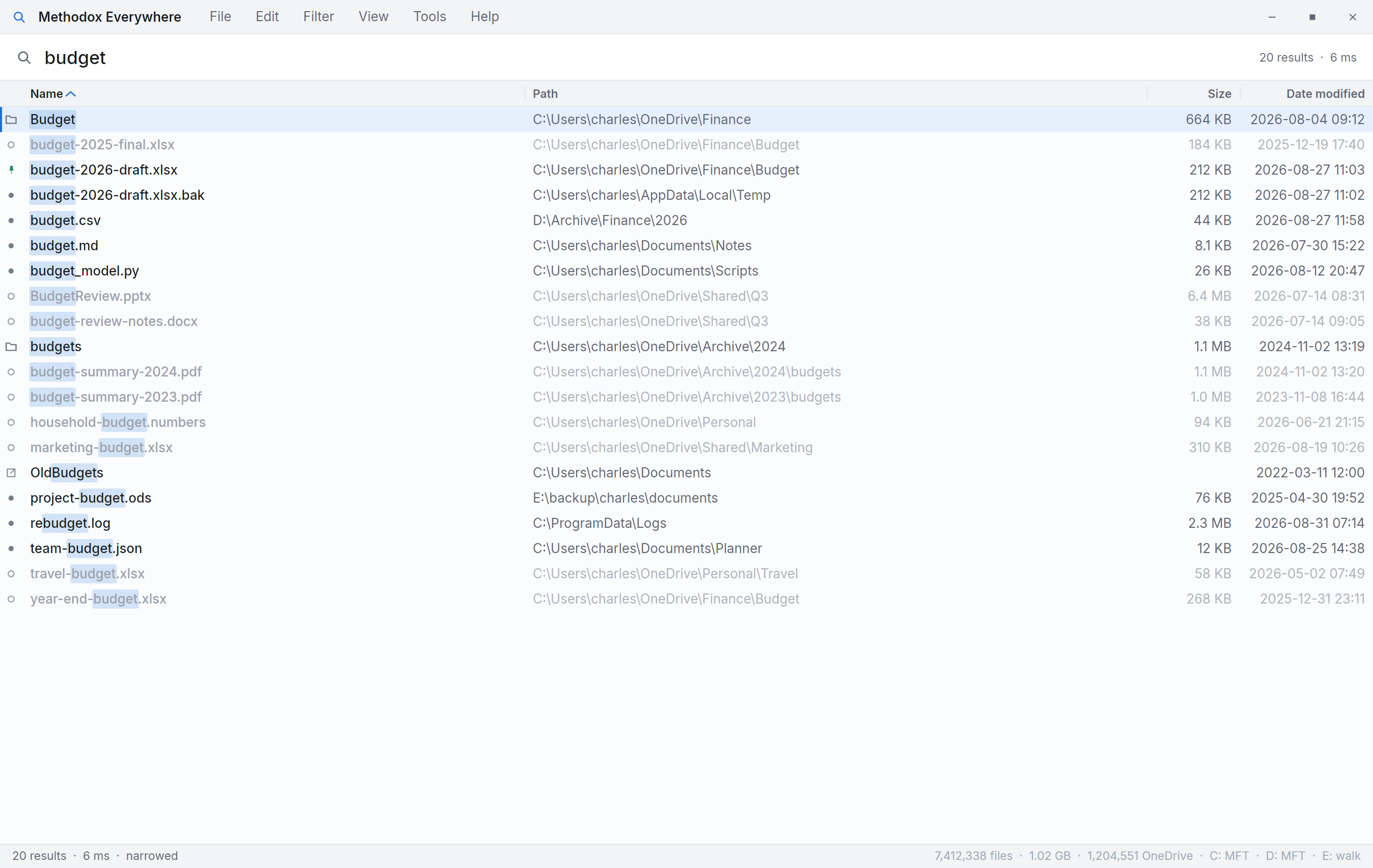
Methodox Everywhere showing results for the word budget across several drives, with file names, paths, sizes and dates.

Results for one word, across every drive, as it was typed.
Instant

Results before you finish the word

Everywhere reads what the file system already knows about your disks instead of crawling them, so the first run takes seconds rather than the hours a background indexer wants. After that it stays current on its own as files are created, renamed and deleted.

Every search runs over the whole catalogue at once. There is nothing to wait for, no progress bar, and no results that arrive late — the list is complete by the time you have stopped typing.

One field

Type part of a name. Type two words and get what matches both. Type part of a path and get everything under it.

Sort anything

By name, folder, size or date, over millions of results, without waiting for the list to catch up.

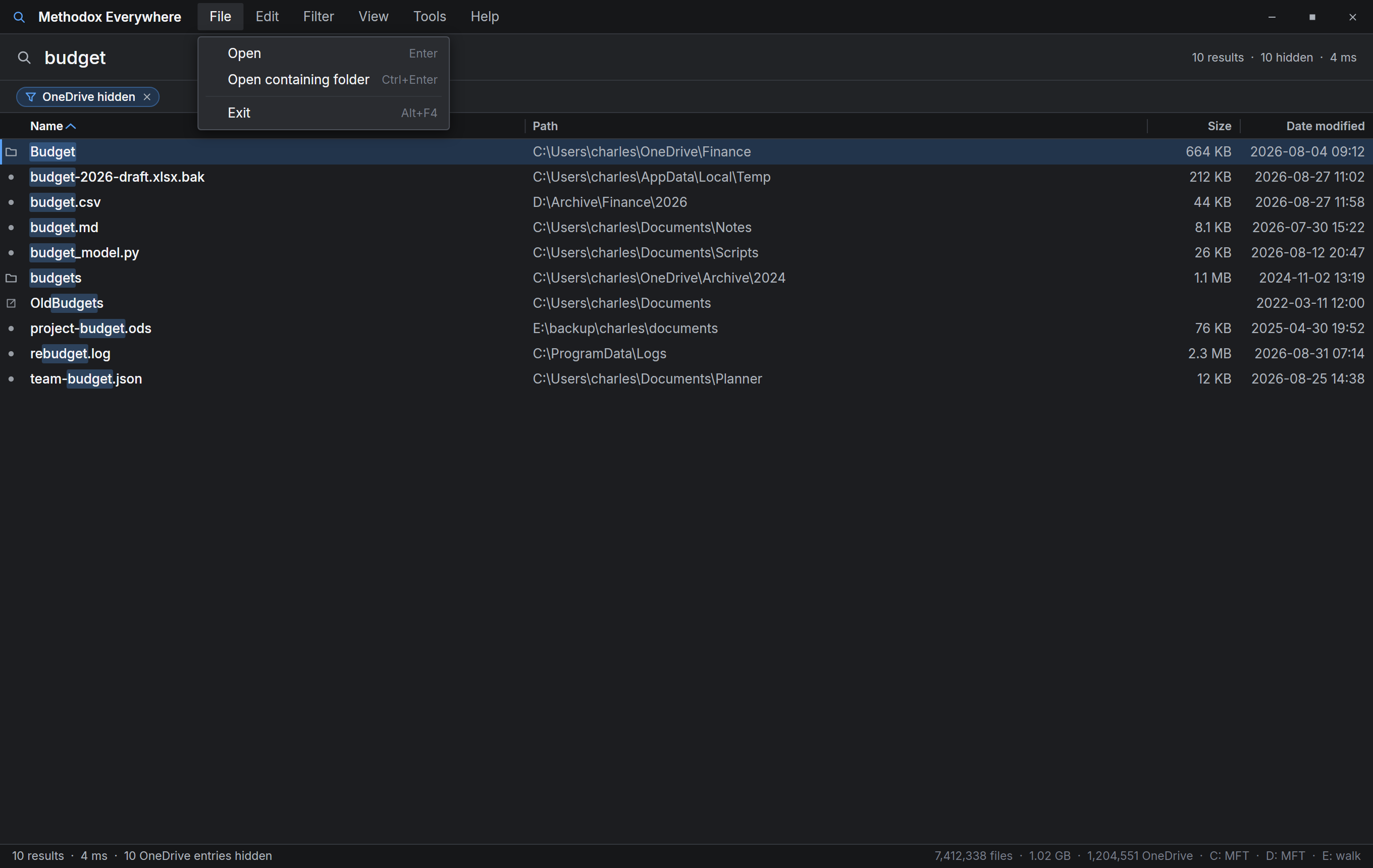
The Filter menu open, offering everything, files only, folders only, and options for hiding cloud files.

Cloud files

It knows which files are really there

A cloud folder lists files whose contents are not on your machine. They have names, sizes and dates like any other, and opening one costs a download — which on a slow connection, a metered one or a plane is not a small thing.

Everywhere tells the difference. A file whose contents are elsewhere is drawn a step back from the rest of the list, so you can see at a glance which results you can actually open. One menu item removes them from every search entirely.

On your disk
Downloaded and kept
In the cloud only
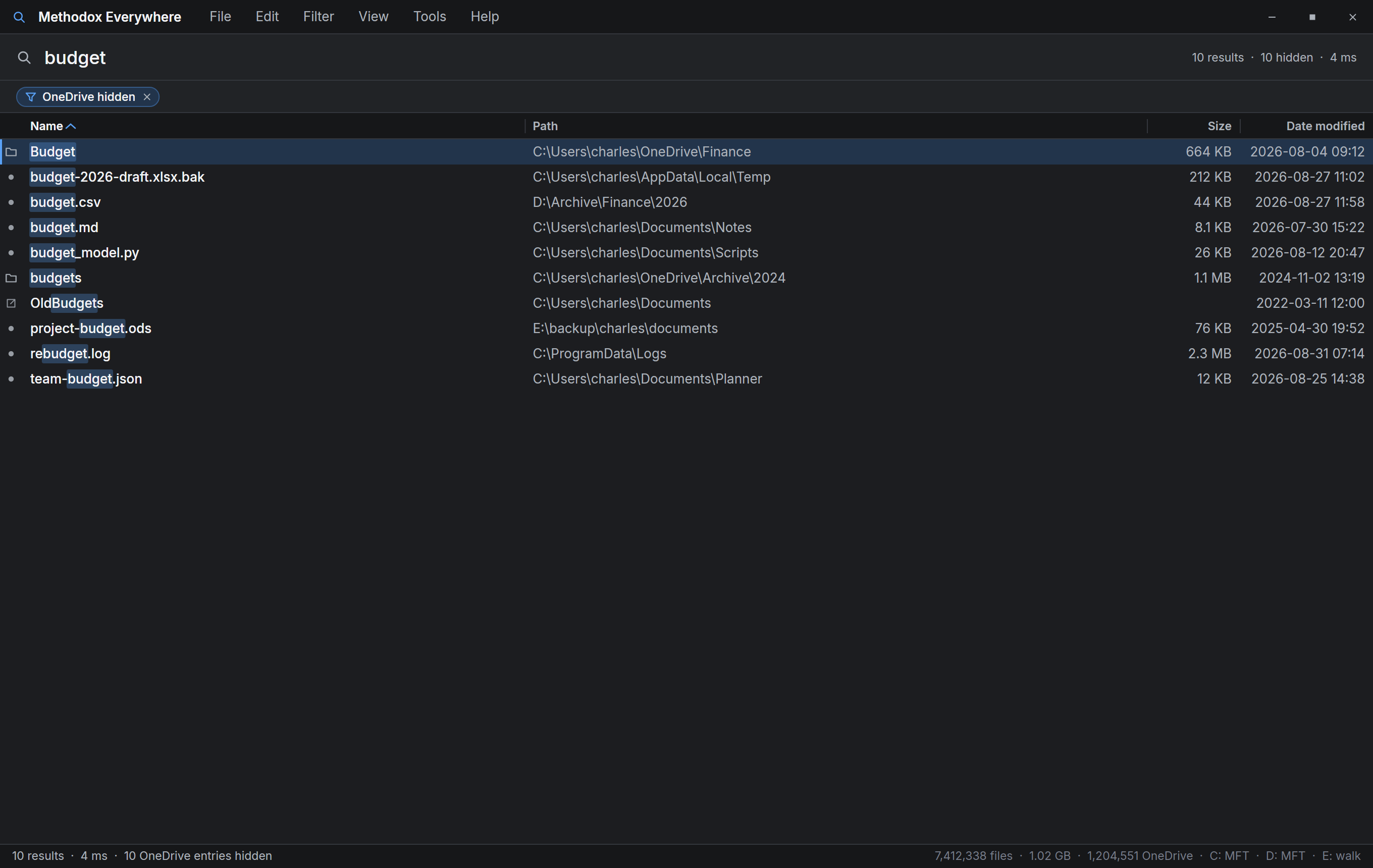
The same search with cloud-only files hidden, and a removable chip under the search box saying so.

The same search with cloud-only files hidden.

Folder sizes

How big is that folder?

Windows will tell you, eventually, one folder at a time. Everywhere already knows: every folder on every drive carries the size of everything inside it, and you can sort by it.

Ask for folders over a gigabyte, sort them largest first, and you have the answer to where the disk went — in about as long as it takes to read this sentence.

Search language

Ordinary words, until you need more

Most searches are a word or two. When one is not enough, there is a small language for saying what you mean — and the built-in help lists all of it without leaving the window.

Right-click any result and search inside its folder without typing a thing.

budget reportboth words, anywhere in the path
*.psdevery Photoshop file on the machine
ext:cs mt:lastweeksource files touched in the last seven days
size:>1gb type:folderthe folders filling the disk
cloud:onlinefiles that would have to download first
local:yesonly what is on this machine

Requirements

What it needs, plainly

Everywhere works the way it does because it uses features that belong to Windows and to the NTFS file system. That buys the speed, and it sets the limits.

  • Windows. There is no macOS or Linux version, and there cannot be a like-for-like one: the capability it is built on is a Windows feature.
  • NTFS drives. Drives formatted another way — many USB sticks and memory cards, for instance — are not listed.
  • Administrator rights, to be fast. Without them Everywhere still finds everything, but the first run takes minutes rather than seconds and cannot keep itself current. It says so plainly when that happens, with a button to restart with the rights it wants.
  • Memory in proportion to your disks. The whole catalogue is held in memory so that searching is instant. A very large drive is a correspondingly large catalogue.
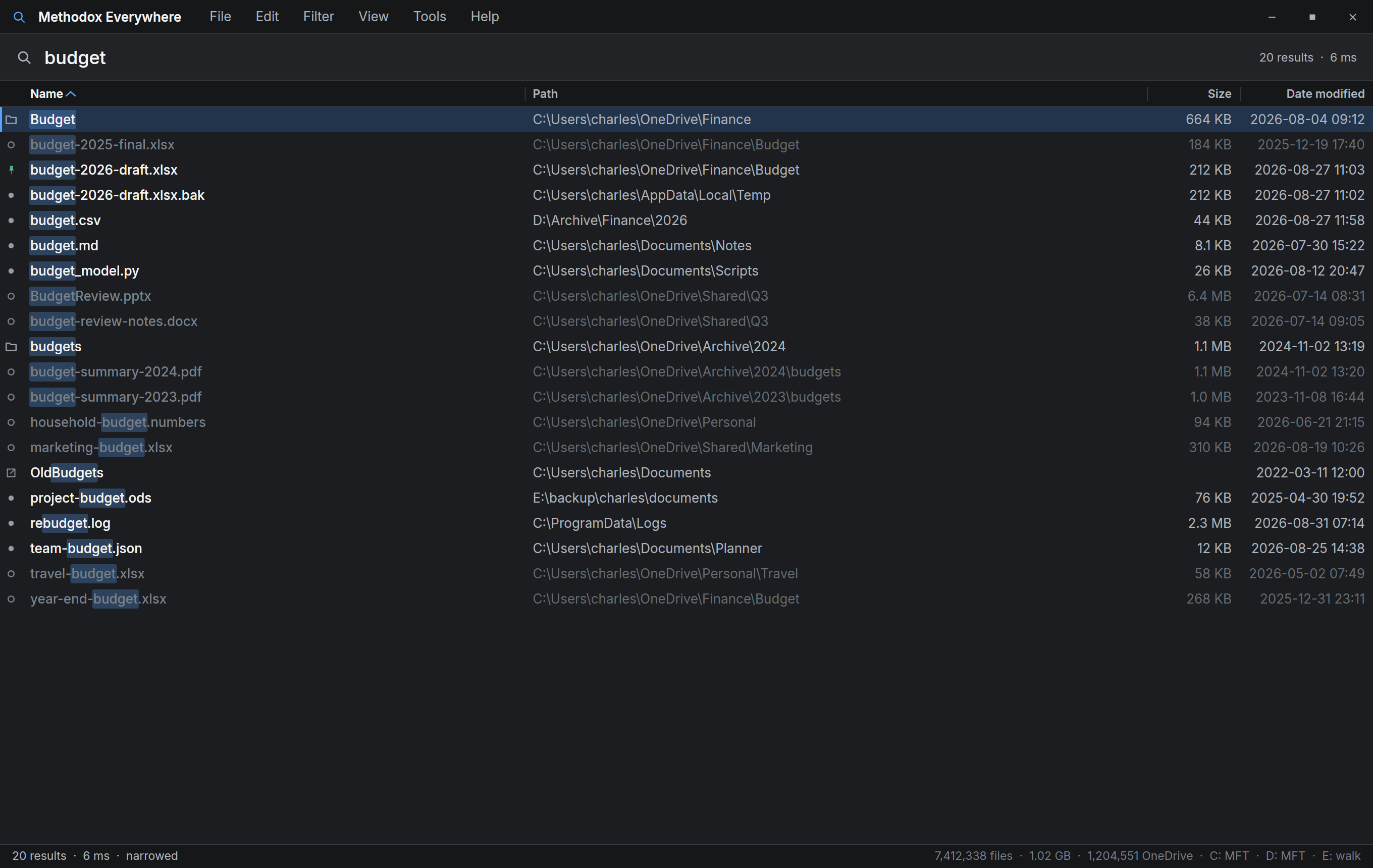
Methodox Everywhere in its light theme, showing the same list of results.

A light theme too, and text that scales as far as you need it to.

Get Methodox Everywhere

A single download. Nothing to configure before it is useful.

Part of the Methodox collection of small, self-contained tools.